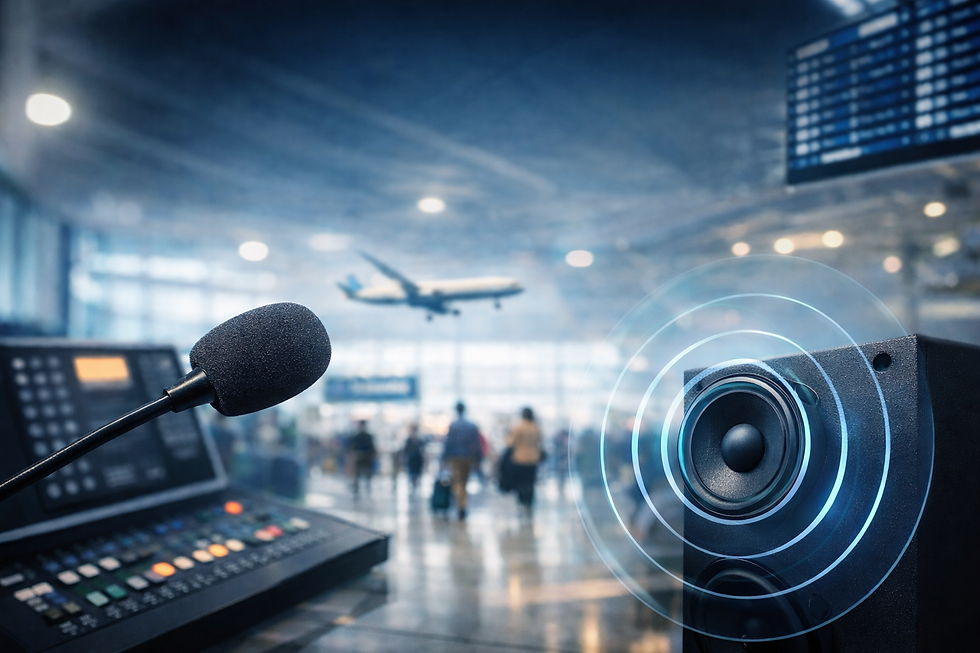
Transforming Airport Announcements into Connected Information
Updated: Sep 30

Airports run on information. Gate changes, boarding calls, delays, all announced live, all spoken aloud. But the moment a PA message ends, it is gone. For millions of passengers every day, that information never truly arrives.
Travelers with hearing impairments miss it entirely. Passengers in noisy terminals or unfamiliar with the language lose critical details. And no system captures what was said: not the screens, not the apps, not the dashboards. The announcement happened. But where did the information go?
This is the gap that speech-to-text technology addresses. And in an airport environment, closing that gap has real consequences for accessibility, passenger experience, and operational clarity.
The Speech-2-text module does not just transcribe. It turns a spoken moment into reusable, structured data available across every connected system.
Why audio alone is not enough
Modern airport environments are complex by nature. They are loud, multilingual, and crowded. The same announcement needs to reach very different people at the same time, and spoken communication alone cannot reliably do that.
Passengers with hearing impairments receive no accessible alternative
High noise levels make spoken messages unreliable even for those without hearing loss
Language barriers mean the message is heard but not understood
Once spoken, information is gone: no record, no distribution, no reuse
Airports are already required to provide inclusive communication for all passengers, aligned with ADA Title V and international accessibility standards. Spoken announcements alone cannot meet that requirement. A readable, visible alternative is not optional. It is a compliance obligation and a passenger expectation.
Relying solely on audio is a communication design problem, not just an accessibility one. The information exists. The challenge is making it travel further.
What makes the PAXGuide approach different
Most speech-to-text systems stop at the transcript. They output a raw text version of what was said and leave it there. That creates a different problem: a full transcript of a PA announcement is often long, filled with standard phrases, and not easy to read quickly on a display.
PAXGuide goes further. After transcription, an intelligent AI summary step identifies the key information automatically and creates a concise, passenger-friendly version. No long paragraphs, no filler, no karaoke-style reading. Just the essential message shown instantly on screens and devices.
The result: passengers see exactly what they need to know, flight number, gate, status, without having to read through a full transcript. The information is accurate, immediate, and easy to act on.
How the PAXGuide Speech-to-Text Module works
The module captures PA announcements, processes them with AI, and distributes the result automatically and in real time. Four clear steps:
1 | Capture Audio from manual PA announcements is captured directly at the source |
2 | Transcribe High-accuracy AI models convert speech to written text in real time |
3 | Summarize Intelligent AI extracts only essential details. No filler, no long paragraphs |
4 | Distribute Results are sent to screens, mobile apps, and operational dashboards instantly |
Each step is designed to preserve accuracy while reducing friction. The passenger does not need to read a full transcript. The operator does not need to manually reformat anything. The system handles it end to end.
Built for existing airport infrastructure
Deploying new technology in an airport environment comes with a clear requirement: it cannot disrupt what is already working. Airports run complex, interdependent systems, and any new module has to fit into that environment without requiring major rebuilds.
The Speech-to-Text Module connects directly to existing paging systems using Sittig's established protocols. No major infrastructure changes are required. For airports that already rely on Sittig's communication infrastructure, the integration is straightforward.
CONNECTS TO
| DEPLOYMENT OPTIONS
|
Once connected, announcement data flows automatically to every linked system. A boarding call spoken at a gate becomes a visible notification on nearby screens, in the passenger app, and in the operational dashboard, all within seconds and without any manual step.
Add-on or standalone: flexible by design
The module works as a dedicated Speech-to-Text engine on its own, or it can be integrated seamlessly into the full PAXGuide ecosystem. Both paths are fully supported.
When combined with the broader PAXGuide platform, the possibilities extend further. PAXGuide can manage multilingual, event-based, and data-triggered announcements using inputs from AODB, FIDS, PFMS, and other airport systems. Speech-to-text becomes one layer in a fully connected passenger communication environment.
This flexibility allows airports to start with what they need today and expand as their requirements grow, without having to replace what they have already built.
More than 30 years of integration expertise
Sittig Technologies brings over three decades of experience connecting to all major PA platforms. The module is built on an open architecture and supports scalable deployment across cloud and on-premise environments.
That depth of experience matters in an airport context. Integration projects that touch live operational systems require a partner who understands both the technical complexity and the operational constraints. The Speech-to-Text Module is not a standalone product dropped into a new environment. It is built on a foundation of proven protocols and real-world airport deployments.
Airports already generate the right information through announcements. The challenge has always been making that information accessible, visible, and usable across systems. The PAXGuide Speech-to-Text Module closes this gap: turning spoken communication into structured data that supports passengers, improves accessibility, and enhances operational transparency for airport and airline operations alike.
For further information, please contact:
Johannes Sittig
CEO US, Sittig Technologies
Tel: +49 69 3700020
E-Mail: info@sittig.de
About Sittig Technologies
Sittig Technologies is a global provider of voice communication and automated announcement solutions for airports and transportation hubs. Founded in 1987 in Germany, the company has built decades of experience in delivering reliable and easy-to-use communication systems for complex public environments.
Airports, Airlines and transportation hubs around the world use Sittig’s PAXGuide system to provide clear, consistent, and multilingual passenger announcements. By automating announcements and connecting them with operational information, PAXGuide helps staff reduce manual effort while ensuring passengers receive timely and accessible information.
Today, Sittig Technologies serves customers worldwide and operates internationally with offices in Europe and the United States.